


[This article was originally written on 25th July 2026 but remain unpublished until 12th September 2026]
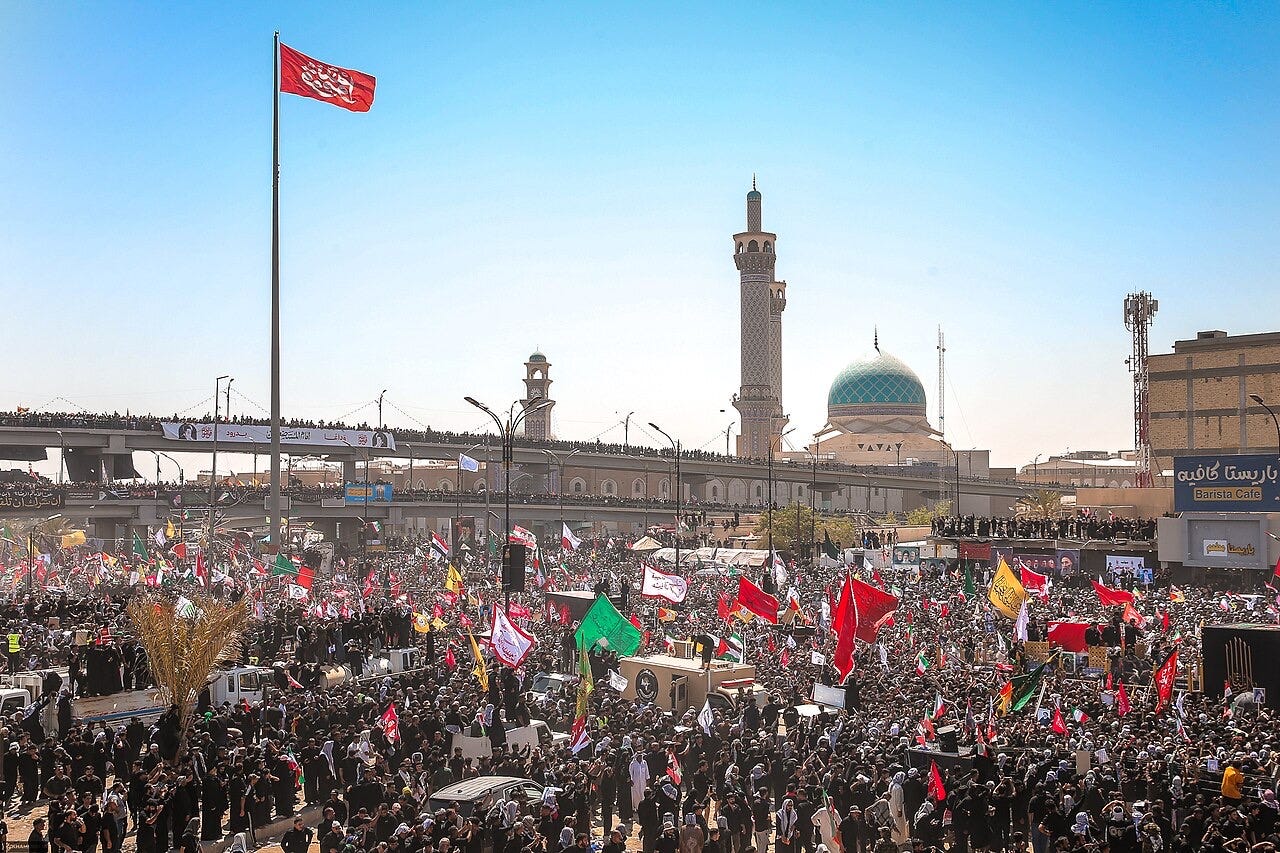
Iran has held a six-day funeral procession for its late Supreme Leader Ali Khamenei. The event congregated mourners, including local religious leaders and decision-makers, throughout political and religious centres in Iran and Iraq, which were of significance in both Khamenei’s life and the recent history of Iran under the Islamic Republic regime.
The elaborate procession was intended as a display of strength and defiance by Iran amidst a new wave of attacks by the US and the (easily anticipated) collapse of the most recent interim peace deal between the United States and Iran –which led President Donald Trump to declare that the ceasefire was “over”, and threaten in no unclear terms “to completely decimate and destroy all areas of Iran."
But the protracted and elaborate funerary ceremony also surfaced some of the fractures that have started to emerge within the Iranian leadership. Namely, “the hostility directed at top officials during the funeral, [which appears to show that] the Islamic Republic’s most radical factions [are at odds] with the wartime leaders who negotiated and signed a peace agreement” with the US.
On the one hand, there is President Masoud Pezeshkian, a relative reformist who criticized the targeting of military and civilian infrastructure in neighboring countries as part of the Iranian response to the US-Israeli attacks of February 2026 –but who ultimately lacked any power to stop the Islamic Revolutionary Guard Corps (IRGC) from conducting them.
On the other, there is Supreme Leader Mojtaba Khamenei, a hardliner who succeeded his father in office, during the aforementioned “targeted” strike campaign. In the usual fashion of the Iranian regime, Khamenei perceives himself to be the true protector of the Iranian nation and the Islamic Revolution. As such, upon the signing of the Memorandum of Understanding (MoU) between President Pezeshkian and President Trump in early June 2026, he promptly expressed that he had “a different opinion, in principle” on it –which means he utterly disagreed with it.
The 14-point preliminary MoU, which had been negotiated by Iran’s Parliamentary Speaker, Mohammad Bagher Ghalibaf, and was mediated by Pakistan, had set a 60-day window to negotiate a permanent peace treaty between the two countries. It is worth noting that Israel did not take part in the US-Iran peace talks, and that it even actively opposed reaching a peace agreement with Iran –despite being the main proponent of the initial attack. This is because Israeli Prime Minister Benjamin Netanyahu needs the war with Iran to continue, so that by extension, it can continue with the occupation of even more Lebanese territory (to purportedly defeat Hezbollah, which Israel claims to be funded by Iran).
Under the terms of the interim peace deal, the US agreed to lift the naval blockade it had imposed on the Strait of Hormuz (which was already blockaded by Iran); waive financial sanctions on Iranian oil; release frozen Iranian assets; and (inexplicably) to create a $300 billion USD private investment fund for Iran –which was purportedly only earmarked for economic development for the country, but that seemed to be more of a compensation for the reconstruction of the infrastructure that the US had damaged or destroyed during the bombing campaign. In exchange, Iran committed to stop the attacks on its neighbours and other targets in the region; keep the Strait open to international shipping –while separate discussions on its administration took place; and most significantly, to not procure or develop nuclear weapons.
None of these commitments satisfied Khamenei. In a written message, he stated that the Iranian “authorities [had] made many efforts out of compassion and goodwill, and of course, it was the President of the United States who, out of desperation, used various levers” to reach an agreement from Iran on the MoU. Despite personally disagreeing with the MoU’s terms, Khamenei said that he still would allow (or at least not fully oppose) its implementation, due to the commitment that the esteemed President Pezeshkian allegedly made to him that “he would accept responsibility for it” –and that if the US were to make “excessive demands”, Iran would not be burdened by them.
Such a cryptic message implied that, if the MoU were to succeed, the Supreme Leader would claim the success for himself and the regime. But if the deal were to fail (as it did), the blame would fall on Pezeshkian’s. To no one’s surprise, the interim deal failed. And just as it had started, on 15th July, the US resumed its airstrike bombing campaign and blockade on Iran.
Already in March 2026, I had anticipated that the US-Israeli bombing campaign over Iran would not produce regime change. Foreseeing that the campaign, promoted by Israeli Prime Minister Benjamin Netanyahu and Trump, would not deliver the expected result was straightforward, considering that the strategy behind it only rested on one expectation. That is, that the bombing campaign would prompt the Iranian civilian population to rise en masse against its government, and the IRGC specifically, to the point of overwhelming them and taking physical and political control of the institutions. Hence, resulting in the regime change that Netanyahu and Trump so desperately want.
But to any careful observer, it should be evident that for now there is no incentive for the Iranian population to rise against their government, especially one that is as oppressive and willing to use deadly force upon dissenters and protesters. With the IRGC being as well established as it currently is to quell any signs of opposition, even at a high human cost for its own population, while fighting the US and Israel externally –and bombing its neighbours in the meantime– there is no real expectation to either collectively prevail in such a fight or individually survive it to see the outcome.
Realistically, there is limited political space for dissenters in Iran to express their profound dissatisfaction (or more precisely, anger) towards their government. Dissenters (on either side of the current Iranian political spectrum, i.e. “reformists” and hardliners) will likely only find such space in massive public displays such as Ali Khamenei’s funeral.
At the funeral, therefore, displays of mourning were also used to send political messages, just as it happened on the very first day of the funeral procession, when foreign diplomatic delegations stood before the late Supreme Leader Khamenei's coffin, and Quranic verses were recited. One of them being Verse 13 of Surah Al Imran, which goes:
"Indeed, there was a sign for you in the two groups that met in battle: one group fighting in the cause of Allah and the other disbelieving. They saw them with their own eyes as twice their number. And Allah supports with His victory whom He wills. Surely, this is a lesson for those who have insight."
And not much insight is needed to see that the Iranian “reformists” are on the losing side of such a battle. And that putting its Supreme Leaders to premature rest will not lead to the Iranian regime’s collapse. On the contrary, it will reaffirm the IRGC’s resolve to continue consolidating power, while Iran’s civilian population pays the human cost of the US newest forever war.